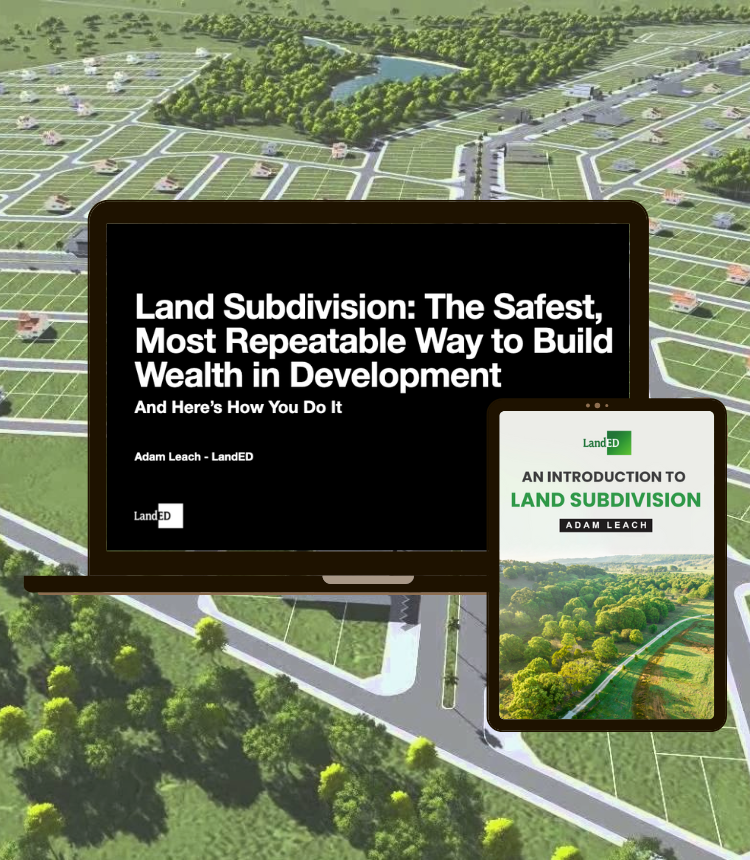
If you're thinking about getting into property development in Australia, you've probably noticed there are two broad paths people take. One is built form development, which means buying land and constructing something on it (houses, townhouses, units). The other is land subdivision, which means buying a larger parcel of land and splitting it into smaller lots to sell.
Most people default to built form because it's what they see. New houses going up on every corner. Townhouse projects getting DA approval. It feels tangible, visible, obvious. But after spending years in the building industry and then transitioning into land subdivision, I can tell you with absolute certainty that subdivision is the better starting point for most people. Not all people. But most.
This guide explains why, compares the two paths honestly across every dimension that matters, and helps you decide which one fits your situation, your capital, and your risk tolerance.
Why I switched from building to subdividing
I ran a successful construction and building company for years. From the outside it looked impressive. Good revenue, busy team, constant projects. But from the inside, I was exhausted.
The overheads were relentless. Staff costs, insurance, vehicle fleets, tool replacements, warranty callbacks. Every project had a hundred moving parts and every one of them could go wrong. A subcontractor no-shows on a Monday morning. Materials get delivered to the wrong site. Rain delays push your programme out by two weeks. A client changes their mind on the kitchen layout after the cabinetry has been ordered.
And the margins never seemed to reflect the effort. After you accounted for everything, a well-run building project might deliver 10% to 15% net margin. On a $500,000 build, that's $50,000 to $75,000 in profit. Sounds decent until you realise it took nine months, consumed all of your time, and required $400,000+ in working capital.
"I was good at building. But I was building someone else's wealth more than my own. I needed a smarter vehicle."
That's when I turned to land subdivision. The first project I did was a simple 1-into-2. Buy a big block. Get council approval to split it into two lots. Sell the lots. No building. No trades. No clients changing their minds about benchtops.
The margin was 32%. The project took eight months. My capital at risk at any given time was less than half what a typical building project required. And, critically, I could manage the entire project in about five hours per week alongside my other work.
That first project changed everything. Over the next two decades, I completed more than 30 subdivision projects totalling over $300 million in value. I still know how to build. I just found a better way to create wealth.
What each path actually involves
Built form development
Built form means you're constructing a physical building. That could be a single house on a vacant lot, a duplex, a set of townhouses, or a small apartment block. The process typically involves buying land, engaging an architect or building designer, obtaining a development application and building approval, hiring a builder (or building yourself if you're licensed), managing construction over 6 to 12 months, and then selling or renting the finished product.
The profit comes from the difference between what the finished building is worth and what it cost you to buy the land, design it, approve it, and build it. Your exposure is high because you're carrying construction costs, builder progress payments, and material costs throughout the entire build.
Land subdivision
Subdivision means you're taking one lot and turning it into two or more lots. You're not building anything on the land (though you can, and some people do). The process typically involves buying a site with subdivision potential, engaging a town planner, surveyor, and civil engineer, obtaining council approval to subdivide, completing civil works (road access, drainage, service connections), and then selling the individual lots.
The profit comes from the fact that two (or three, or ten) individual lots are worth more in total than the one larger parcel you started with. Your exposure is lower because you're not carrying construction costs. The most expensive part of a subdivision is typically the civil works and council infrastructure charges, which are a fraction of what construction costs on a built form project.
The side-by-side comparison
Here's how the two paths compare across the dimensions that matter most when you're deciding where to start.
The table tells a clear story. Subdivision offers better margins, lower capital requirements, less complexity, and lower risk. But let me unpack each of these because the nuance matters.
Capital requirements
This is the single biggest practical difference between the two paths. With subdivision, your capital outlay is primarily the land purchase plus subdivision costs (council fees, civil engineering, surveyor, planner, service connections). On a typical 1-into-2 project in a suburban area, your total capital requirement might be $150,000 to $300,000 depending on the land price and complexity.
With built form, you need that same land cost plus full construction costs. A basic 3-bedroom home costs $250,000 to $400,000 to build. A duplex is $450,000 to $700,000. Townhouses or units are significantly more. Your total capital requirement for a built form project can easily be $500,000 to $1,000,000+.
This matters for two reasons. First, more capital at risk means more to lose if something goes wrong. Second, borrowing $500,000+ for a development project requires a significantly stronger financial position than borrowing $200,000. The lending criteria are tighter, the equity requirements are higher, and the interest burden during construction is much larger.
On a typical 1-into-2 subdivision, you might have $180,000 in total non-land costs (council fees, civil works, consultants, holding costs). On a typical duplex build, you'd have $600,000+ in construction and non-land costs. The subdivision has one-third of the cost exposure, but often delivers a higher margin percentage. That's a fundamentally better risk-reward equation.
Risk profile
Every development project carries risk. The question is how many sources of risk you're exposed to, and how severe each one can be.
With subdivision, your main risks are:
- Planning risk: Council could refuse your application or impose conditions that change the economics
- Civil works risk: Earthworks and drainage could come in over budget (typically $10,000–$30,000 variance)
- Market risk: Lot values could soften between purchase and sale
- Timeline risk: Council could take longer than expected, adding holding costs
With built form, you carry all of those risks plus:
- Construction risk: Builder disputes, defective work, weather delays, subcontractor issues
- Cost escalation: Material prices can shift significantly during a 9–12 month build
- Design and compliance risk: Building doesn't meet code, requires rectification work
- Warranty risk: Structural or waterproofing defects discovered after completion
- Buyer expectations: Finished-home buyers are far more demanding than land buyers
The built form risk stack is roughly three times deeper than the subdivision risk stack. And critically, the dollar impact of each construction risk is typically larger. A builder walking off a job mid-construction can cost you $50,000 to $100,000 to resolve. A civil works cost overrun on a subdivision is usually $10,000 to $30,000.
Margins and profit
This surprises most people. How can you make a higher margin on subdivision, where you're "just splitting land," than on a full construction project where you're "adding real value" by building something?
The answer is costs. Built form has dramatically higher costs, and those costs eat into the spread between what you pay and what you sell for. A house that sells for $800,000 might cost $600,000 to buy the land and build, leaving $200,000 gross profit on $600,000 costs, a 33% margin. Sounds good. But that $600,000 cost base includes dozens of line items, any one of which can blow out. In practice, after all the surprises, the actual margin on a well-managed build project is typically 10% to 20%.
A subdivision that creates two lots worth $520,000 each ($1,040,000 total) from a site purchased for $580,000, with $200,000 in subdivision costs, has a cost base of $780,000 and a gross profit of $260,000. That's a 33% margin. But critically, the cost base has far fewer line items, far less variability, and far fewer opportunities to blow out. In practice, a well-managed subdivision typically delivers 25% to 35%.
"In built form, you can do everything right and still end up with 12% margin because of things outside your control. In subdivision, the numbers are simpler, more predictable, and more within your control. That's why the margins hold up better in reality."
Complexity and moving parts
A typical built form project requires you to coordinate an architect or building designer, a structural engineer, an energy assessor, a builder, and then 15 to 25 subcontractor trades: concreters, framers, plumbers, electricians, tilers, plasterers, painters, landscapers, the list goes on. Every one of these people has their own schedule, their own priorities, and their own capacity to cause delays.
A typical subdivision requires a town planner, a surveyor, a civil engineer (and their construction crew), and a solicitor. That's it. Four to five key relationships. Each one has a clearly defined scope, a predictable timeline, and established fee structures. You can learn what "good" looks like for each of these consultants in a matter of weeks.
This difference in complexity is why I say subdivision can be done alongside a full-time job. During most phases of a subdivision project, your active involvement is five to ten hours per week: reviewing reports, approving plans, making phone calls, attending a site meeting. During a built form project, particularly during construction, you're effectively running a full-time operation.
Ready to find your first subdivision site?
The Master Land Subdivision online course gives you the complete framework for finding, evaluating, and executing a profitable subdivision project from start to finish.
Get the Online Course →Timelines
A typical 1-into-2 subdivision in Australia follows this rough timeline:
- Site search and due diligence: 1–3 months
- Purchase and settlement: 1–2 months
- DA preparation and lodgement: 1–2 months
- Council assessment: 3–9 months (varies significantly by council)
- Civil works: 2–4 months
- Plan sealing, titles, and settlement: 2–3 months
Total: roughly 10 to 18 months from identifying the site to receiving your money.
A typical built form project adds 6 to 12 months of construction time on top of the approval process. So you're looking at 18 to 30 months from identifying the site to receiving your money. That's 6 to 12 additional months of holding costs, additional months of risk exposure, and additional months of your life tied up in the project.
Time is money in development. Every additional month costs you interest, rates, insurance, and opportunity cost. The shorter timeline of subdivision means you get your capital back faster and can recycle it into the next deal sooner.
Which path suits which person
Subdivision is usually the better fit if you:
- Have limited capital (under $300,000 available)
- Want to do this alongside a full-time job or business
- Don't have a construction background or builder's licence
- Prefer lower complexity and fewer moving parts
- Want to learn the development process before committing to larger projects
- Value capital efficiency and faster return on investment
Built form might be the better fit if you:
- Already hold a builder's licence or run a construction business
- Have significant capital available ($500,000+) and want to maximise total dollar profit per project
- Are willing to make development your primary occupation during the project
- Have established relationships with reliable trades and subcontractors
- Want to create a finished product you can also hold as a rental asset
Why a construction business owner chose subdivision first
Daniel C. from Western Australia runs a successful construction business. He already knew how to build. He could have jumped straight into a built form development. Instead, he joined LandED to learn subdivision first.
His reasoning: "I've been in construction for years and always saw the numbers working on development projects, but I never had the confidence to pull the trigger. The subdivision program showed me how to de-risk a deal before I commit capital. My goal is to be a full-time developer within two years, and subdivision is the stepping stone."
Daniel understood that even with a construction background, the development skills (site selection, feasibility, deal structuring, planning) are completely different from building skills. Subdivision let him learn those development skills on simpler projects before scaling into built form where his construction background becomes a genuine competitive advantage.
The hybrid approach
Many experienced developers end up doing both. They subdivide a parcel of land into multiple lots, sell some lots to recover capital, and build on the retained lots to maximise total profit. This is sometimes called "subdivide and build" or a "staged development."
It's a powerful strategy, but it's not a starting point. You need to understand subdivision thoroughly before you layer construction on top. The development fundamentals (site selection, feasibility, deal structuring, council approvals, project management) are the same regardless of whether you build or not. Master those first with a simple subdivision, and the built form layer becomes much less risky when you add it later.
Some of our students started with a simple 1-into-2 lot subdivision, then did a 1-into-3 where they built on one lot and sold the other two, then moved into larger projects combining subdivision with built form. Each project built on the skills and confidence from the last one. That's the path I recommend.
"Subdivision teaches you the development skills. Built form lets you apply them. Get the order right and you'll build wealth faster than if you tried to learn everything at once on a complex project."
What comes next
If you've read this far, you're probably leaning toward subdivision as your starting point. The next question is: where do you actually begin?
The first practical step is learning how to find sites with subdivision potential. Our guide on How to Find Subdivision Sites Using Free Online Tools walks you through the exact process, including the free state-by-state mapping tools that show you zoning, overlays, and lot sizes for every property in Australia.
Once you've found a potential site, you need to know whether the numbers work. Our guide on The 30% Margin Rule explains the feasibility calculation that tells you whether a deal is worth pursuing or whether you should walk away.
If you want to understand whether you're ready to start looking at deals right now, take our free readiness quiz. It takes a few minutes and gives you a clear picture of where you stand.
And if you're ready for the full framework, the Master Land Subdivision online course covers everything from site search to settlement, step by step.
The path from where you are now to a completed, profitable subdivision project is shorter than you think. And it starts with a decision: simpler path first, complex path later. Most of the students who've achieved real results through LandED started exactly this way.